
How Our Blackbook Analysis Starts Weeks Before Race Day

Some of our most useful racing work starts weeks before there is a bet to place.
A horse might catch our eye in a trial or jump-out. It might be held up at a key stage, finish better than the result suggests or show something the market has barely seen.
We record it, follow it and wait.
That is where our Blackbook analysis begins.
It is easy to spot a promising run and then lose track of the horse as attention moves to the next meeting. By the time it reappears, the market may already have noticed what made the earlier performance interesting.
Our Blackbook process is designed to preserve that early information and bring it back into the analysis when the horse races again.
The process starts well before race day, but a Blackbook note is only the beginning.
The Best Racing Tips Can Begin Long Before Acceptances
A race-day selection is the end of the process. The useful information may have appeared several weeks earlier.
We Are Looking for Information the Result Does Not Show
Finishing positions tell us what happened. Replays can help explain how it happened.
We look for horses that travelled strongly, lost momentum, covered extra ground, hit the line with more to give or raced in circumstances that may have hidden the merit of the performance.
With lightly raced horses, we also watch for signs of learning, improvement or a developing pattern that may not yet be obvious from exposed form.
Those details are easy to lose if all you keep is the finishing position.
A Horse to Follow Still Has to Earn the Bet
A Blackbook entry gives us a reason to reassess a horse. It does not make the next start an automatic bet.
The distance may be wrong. The barrier may create a difficult map. The track may not suit. The opposition may be stronger.
The price may also have disappeared.
We keep the original observation, then test it against the next race.
For a deeper look at that stage of the process, see When a Blackbook Horse Becomes a Bet.
How We Find Blackbook Horses Before the Market Catches Up
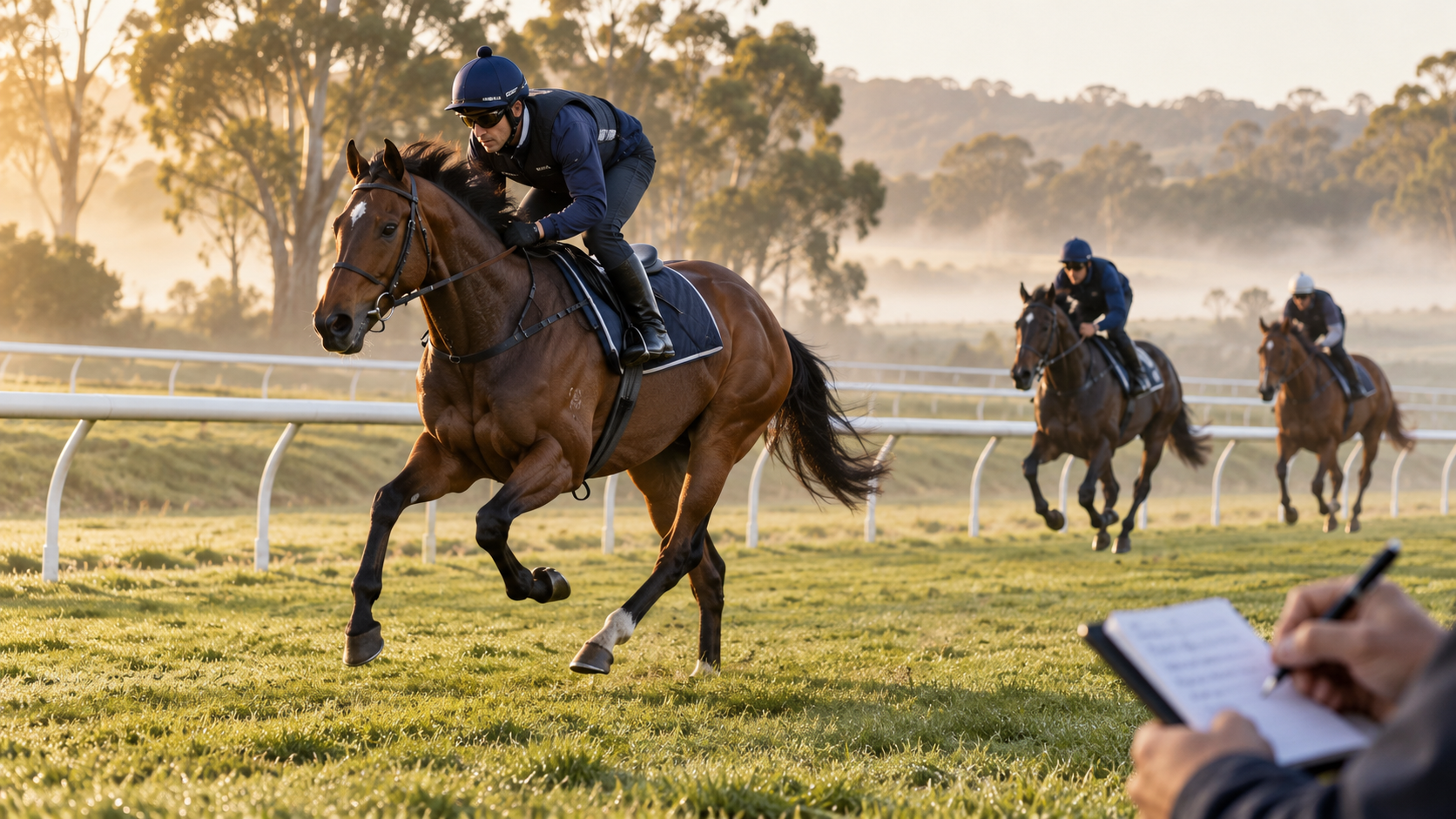
Trial analysis and jump-out work are particularly useful around young or lightly raced horses because there may be limited public race form to assess.
Trials and Jump-Outs Give Us an Earlier Look
We watch more than who finishes first.
According to Racing Victoria, more than 350 sets of jump-outs are conducted across Victoria each year. With so much pre-race activity available to analyse, keeping structured observations helps us follow horses whose performances deserve another look. The footage gives us an opportunity to assess how horses are progressing before their next race, while our Blackbook keeps those observations available for future assessments.
How comfortably did the horse travel? What happened when pressure was applied? Did it have room to extend? Was the rider asking for an effort? Did the horse handle the experience cleanly?
A trial winner can be obvious and still offer little betting value at its next start if everyone saw the same performance.
Young Horses Can Change Quickly
Our bloodstock background adds another layer when we assess young or lightly raced horses.
Pedigree, maturity and likely development can help us interpret what a horse is showing before its race record becomes extensive.
They do not create certainty. They provide additional context while the evidence is still developing.
At that stage, we are not trying to label a horse too early. We are deciding whether there is enough evidence to keep watching.
The Run Everyone Forgets Can Become the One We Keep
Form guides preserve the official result. They cannot capture every decision, interruption or tactical disadvantage inside a race.
A horse can finish fifth after being held up, covering extra ground or settling in the wrong part of a slowly run race.
The number beside its name still says fifth.
Our replay note records why the run may deserve another look.
Weeks later, that detail can become useful again.
This is one of the main purposes of a Blackbook. Memory is unreliable. A structured record keeps the original observation attached to the horse.
Our Blackbook Is a Pipeline, Not a Betting Sheet
We use the Blackbook to carry an observation forward rather than turn every interesting horse into an immediate selection.
A horse may need another run. It may need more ground. It may be better suited on a different surface or from a kinder barrier.
We can continue following it through those changes without forcing a bet simply because its name has appeared again.
A simple version of the process looks like this:
| Stage | What we assess | What happens next |
| Spot | Trials, jump-outs, hidden race merit or development | Record why the horse deserves another look |
| Follow | Subsequent runs, distance, surface and barriers | Keep the original observation in context |
| Reassess | Race map, tempo, conditions, opposition and preparation | Decide whether the new setup improves the case |
| Price | Available odds against our assessment | Bet only if the opportunity still makes sense |
A horse can remain on our radar for weeks or months.
We are comfortable waiting for the right setup rather than forcing a decision.
Finding the Horse Early Only Counts If the Next Race Is Right
Early information is useful only if the next race is assessed properly.
We reassess the barrier, likely tempo, track conditions, distance, opposition, jockey and trainer patterns, the horse’s stage of preparation and the available price.
The original Blackbook note tells us what deserves attention.
The current race tells us whether the setup has improved.
Price Still Gets the Final Say
We can like the horse and still leave the bet alone.
If the market has shortened the price beyond the chance we give it, the original observation may still have been correct while the betting opportunity has disappeared.
That is an important part of value betting. Rating the horse and deciding whether to bet are separate decisions.
No edge. No bet.
The Edge Often Appears Before the Form Becomes Obvious
The earlier stages of a horse’s preparation can require more interpretation because there may be less exposed race form available.
Trials, jump-outs, hidden race merit, pedigree and development can each add context before the horse has built an extensive public record.
That is why we spend considerable time assessing young and lightly raced horses.
The aim is to identify useful information early, record it accurately and continue testing it as the horse develops.
Our guide Identifying Talent Before the Market Recognises It goes further into how we assess that early information.
What Our Blackbook Saves You From Rebuilding Every Week
Plenty of experienced punters can analyse a race.
Finding the time to follow horses across trials, jump-outs, races and preparations is often the harder part.
That work creates a growing information load. Our Blackbook gives those observations somewhere to live, so the original reasoning is still available when the horse reappears.
Subscribers can assess the next race with the earlier trial, replay or development context already attached rather than trying to remember why the horse stood out weeks or months earlier.
You still decide how you bet.
We provide the research, tracking and analysis around the opportunity.
A Blackbook Edge Is Built Early and Tested Again on Race Day
The process is simple to describe but demanding to maintain.
We spot something worth recording. We follow the horse. We reassess the next suitable race. We judge the available price.
Then we decide whether there is a bet.
Some Blackbook horses will never become a betting opportunity for us. Others may reach the right race after weeks of waiting.
That selectivity is part of the process.
If you want to see how our Blackbook analysis fits with our wider race previews, tips and analysis, review the Jig Racing subscription options to see whether the approach suits the way you bet.
Questions Worth Asking Before You Follow a Blackbook Horse
What makes us add a horse to the Blackbook?
We are looking for evidence worth carrying forward. That might come from an unlucky run, a strong trial or jump-out, hidden replay merit, signs of development or placement that gives us a reason to reassess the horse later.
Is every Blackbook horse a bet at its next start?
No. The horse still has to suit the race. We reassess the map, distance, track, opposition and price before making a betting decision.
What can trials show that race form cannot?
Trials can provide an earlier look at how a horse travels, responds to pressure and handles its work before it has much exposed race form. This can be particularly useful with juveniles and lightly raced horses.
How long can a horse stay in the Blackbook?
There is no fixed period. We may follow a horse across several starts or a full preparation if the conditions we are looking for have not appeared.
What happens if the market finds the horse first?
We reassess the price. A horse can remain one we rate while the available odds make the bet unattractive.
What is the main value of the Blackbook for a subscriber?
It keeps the original observation connected to the horse as its career develops. The next race can then be assessed with the earlier trial, replay or development note still in view.
Horse racing involves financial risk, and no analysis can guarantee a winning outcome. Bet within your means and use responsible gambling support if wagering stops being enjoyable or controlled.
Recent Posts

27 October, 2026
Spring Racing Carnival 2026 Races and Horses to Follow