
Why Josh McLoughlan’s Background Matters More Than Another Tipster’s Strike Rate Screenshot
Why Josh McLoughlan’s Background Matters More Than Another Tipster’s Strike Rate Screenshot
A strike rate screenshot shows what the person posting it wants you to see.
It may feature winners while leaving out advised prices, losing runs, staking, sample size and the timing of each selection. The image may be genuine, but it still gives you limited information about the quality of the analysis behind it.
A better question is: how was the selection reached?
I am Josh McLoughlan, the analyst behind Jig Racing. My approach is shaped by bloodstock experience, trial analysis, juvenile racing and years spent assessing horses before their ability becomes obvious to the wider market.
I grew up in Berriwillock in country Victoria before entering the bloodstock industry and working in Singapore. That experience continues to influence how I assess young horses, interpret limited form and decide whether the available price represents value.
A Strike Rate Screenshot Cannot Show You the Work
A screenshot shows a result. It does not explain the process that produced it.
A proper assessment of a tipping service should consider:
- The number of selections
- The period being measured
- Advised prices
- Staking
- Complete results
- Losing runs
- Whether selections were available before prices moved
A headline strike rate without that context can make an ordinary record appear stronger than it is.
The Numbers Missing From Most Tipster Posts
Strike rate is only one measure. Price determines whether a bet offered value.
A tipster can find plenty of short-priced winners and still provide poor betting advice. Another analyst may operate at a lower strike rate while consistently identifying horses at prices above their assessed chance.
A cropped image rarely explains that distinction.
| What a screenshot may show | What serious punters should also check |
| Number of winners | Total number of selections |
| Strike rate | Advised prices and market movement |
| A profitable day or week | Results across a meaningful period |
| Selected successful bets | Complete winning and losing record |
| Headline returns | Staking method and risk |
| Confidence after the result | Reasoning published before the race |
Losing runs also matter. Every betting method experiences them. Anyone presenting racing as a smooth sequence of winners is offering a version of the sport that does not exist.
The Questions Serious Punters Should Ask
Ask whether the analyst explains:
- The likely race map
- Track and race conditions
- The strength of the opposition
- Trial and jump-out form
- The available price
- Why a race should be avoided
Review older selections rather than judging a service on a hand-picked run from one Saturday.
Most importantly, look for a process that can be repeated.
That scrutiny matters in a sizeable racing-betting market. The Australian Institute of Family Studies found that 17.8% of Australian adults participated in race betting at least once in the 12 months prior to October 2024. When racing information reaches such a broad audience, it makes sense to look beyond isolated winning screenshots and examine the quality and consistency of the analysis behind them.
A winner backed for poor reasons may be luck. A loser backed at genuine value can still reflect a sound decision. Serious analysis must be judged across both outcomes.
My Edge Was Built in Bloodstock
My bloodstock background taught me to assess the horse before assessing the market.
Pedigree, physical development, maturity, action and likely distance range can all matter, particularly with lightly raced horses.
Standard form data has less to reveal in a maiden or juvenile race because the public evidence is limited. That creates more room for informed judgement, but it also increases the need for disciplined analysis.
Juvenile Racing Rewards Specialist Knowledge
Two-year-old and three-year-old races form a major part of my work.
Young horses can improve quickly. A plain debut may hide a horse that is still learning its job. A sharp trial may be less impressive than it looks if the horse received every favour and faced little pressure.
I spend more than 60 hours each week studying trials and jump-outs from Victoria through to Hong Kong, with a strong focus on the juvenile market.
That work supports Jig Racing’s selective approach. We release analysis when we believe the form presents a genuine angle. We do not need to manufacture a bet for every meeting.
Trials and Jump-Outs Show What the Form Guide Misses
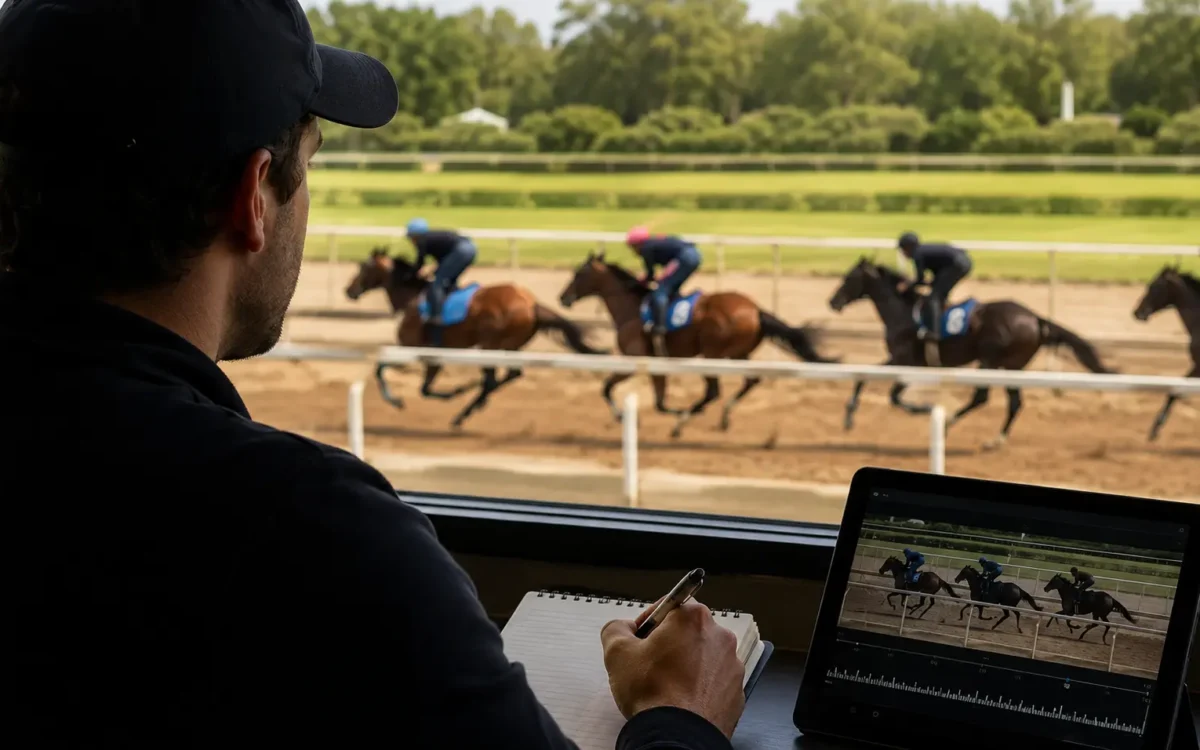
Finishing order is the most obvious part of a trial, but it is not always the most useful.
I am also watching:
- How the horse travelled
- Whether it settled
- How much pressure it faced
- Whether it changed stride cleanly
- How strongly it finished
- Whether it appeared capable of doing more
Those details help separate a trial winner from a horse worth following.
How I Read a Young Horse Before the Market Catches Up
A trial must be considered alongside pedigree, race shape, stable patterns and likely placement. One clue is never enough.
A staying-bred juvenile showing natural speed may be worth noting. A well-bred horse struggling under pressure in a soft trial may be less advanced than the market assumes. A runner held together while others are being pushed may have more to offer.
The final question is price.
Strong form at the wrong price does not provide an edge.
Golden Monkey Was a Test of Judgement
Golden Monkey is one example of bloodstock judgement becoming racecourse evidence.
I purchased him as a three-year-old, five-start maiden from Victoria. He raced under the Jig Racing banner and went on to win the 2023 Group 1 Singapore Derby.
Independent racing coverage also credited me with finding the horse.
One result does not make every future opinion correct. It does, however, illustrate the type of judgement my background is intended to support: identifying potential before the exposed record makes it easy for everyone to see.
Industry Experience Has to Change the Analysis
Credentials have little value if they sit on an About Us page and disappear on race day.
My bloodstock experience influences how I assess pedigree, development and race placement. Trial study changes how I interpret hidden effort. Race analysis adds tempo, speed maps, track conditions, distance, jockeys, trainers and opposition.
I then compare my assessed chance with the market price.
The Process Behind a Jig Racing Selection
The process is disciplined:
- Review exposed form, replays, trials and jump-outs.
- Assess the horse’s development and scope for improvement.
- Map the race and expected tempo.
- Check distance, surface and track conditions.
- Assess the opposition.
- Compare the runner’s chance with the available price.
- Bet, watch or pass.
That final option matters.
There is no edge in producing a selection simply to fill a content schedule. Jig Racing publishes previews and tips for carefully selected races, and there may be days when no selections are released.
Subscribers also receive race previews, late mail, text and voice analysis, and Blackbook tracking for horses worth following.
Media Exposure Gives You a Chance to Test the Thinking
Media appearances give you an opportunity to hear how I reach an opinion.
Jig Racing’s media archive includes content and appearances across Piranha Media, Racing HQ and The Verdict.
This allows you to assess the reasoning in context rather than relying on a promotional claim.
Listen to the Reasoning, Then Make Your Call
Winning bets matter, but understanding why they were selected tells you more about the quality of the analyst.
Listen for specifics.
Does the analyst understand the horse? Can the likely race shape be explained? Is the available price part of the decision? Is there a clear reason to bet, watch or pass?
Review the reasoning, compare it with the result and decide whether the approach suits the way you want to assess racing information.
Judge Jig Racing on the Work
You do not need another carefully selected screenshot. You need enough evidence to decide whether the process suits the way you want to bet.
Before joining, you can:
- Read my background on the Jig Racing About Us page
- Listen to the media analysis
- Review the service’s selective approach
- Check the current Packages and FAQ pages
- Ask direct questions through the Contact Us page
I will never tell you that racing is risk-free. No analyst can guarantee a result, and losing runs are unavoidable.
My job is to study the available evidence, identify races where the analysis supports a position and leave the rest alone.
Review the work, understand the service and decide whether that approach is right for you.
Before You Trust the Next Screenshot, Ask These Questions
Is strike rate enough to judge a horse racing tipster?
No. Strike rate should be considered alongside advised prices, sample size, staking and a complete performance record. A percentage without context can hide poor value or selective reporting.
How does bloodstock experience improve race analysis?
Bloodstock work develops judgement around pedigree, maturity, physical development and likely improvement. These factors can carry additional weight in juvenile races and maidens where exposed form is limited.
Why do trials and jump-outs matter for lightly raced horses?
They can reveal behaviour and ability that a basic results line cannot capture. Useful detail often sits in how a horse travelled, responded to pressure and finished through the line.
Does media exposure prove that a tipster is profitable?
No. Media exposure gives you more material with which to assess the quality and consistency of the reasoning. Profitability requires complete and transparent performance evidence across a meaningful period.
Can Jig Racing guarantee that I will make a profit?
No. Horse racing carries risk, and losing runs are unavoidable. Jig Racing provides analysis, selections and tools designed to support disciplined decisions, but no result is guaranteed.
What should I review before joining Jig Racing?
Review Josh McLoughlan’s background, the depth of the analysis, service features, subscription terms and cancellation process. Check the current Packages and FAQ pages, then contact the team if anything remains unclear.
Recent Posts

21 August, 2026
Piranha Media 20/8/26