

How to Use Sectional Times to Find Hidden Merit in Horse Racing
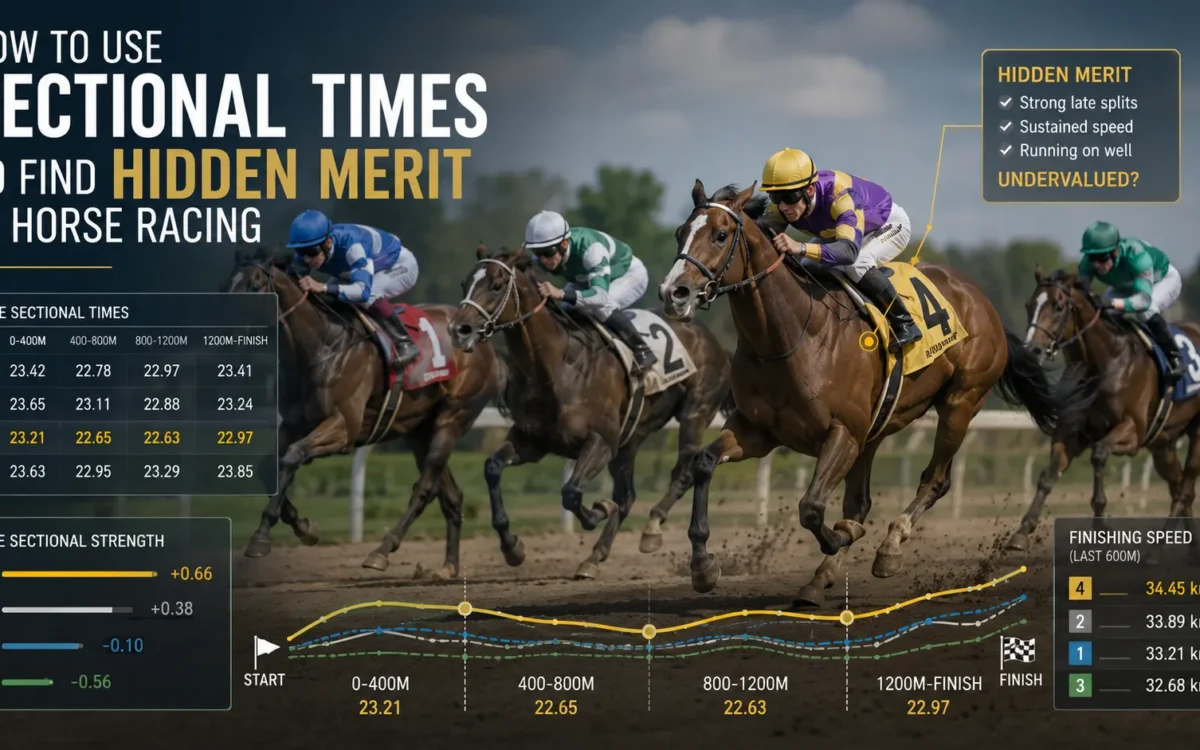
Most punters start with the result.
Winner. Placegetter. Margin. Perhaps a quick replay.
But a finishing position only shows what happened at the line. It does not explain how the race unfolded, which horses were suited by the tempo, who was caught wide or which runner produced a better effort than the result suggests.
That is where sectional times become useful.
By breaking a race into measured segments, sectionals help reveal the effort behind the finishing position. When combined with speed maps, tempo and race context, they can highlight hidden merit before it becomes obvious to the wider market.
Why Finishing Positions Can Be Misleading
A finishing position is useful, but blunt.
A horse can finish fourth after covering extra ground, racing without cover or making an early move into a strong tempo. Another can win after controlling the race from the lead and receiving every advantage.
The result will favour the winner. The underlying performance may tell a different story.
A slowly run race can flatter horses that settle near the lead. A high pressure race can weaken those involved in the early speed and favour runners that conserve energy behind them.
Other horses may be held up, forced wide or asked to accelerate earlier than ideal. Their final placing may look ordinary even though the effort was strong.
The result tells you where a horse finished. It does not always tell you which horse produced the most valuable performance.
What Are Sectional Times in Horse Racing?
What Are Sectional Times in Horse Racing?
Sectional times divide a race into smaller measured segments.
Depending on the available data, these may include:
- Early race splits
- Mid-race splits
- The final 600 metres
- The final 400 metres
- The final 200 metres
These figures help explain how quickly different stages of the race were run.
Australian racehorse biometric research shows how meaningful small changes in late-race performance can be. University of Melbourne researchers found that injury risk increased by 18% when a horse’s speed decreased by 0.1 metres per second during the final section of a race. A 10-centimetre reduction in stride length was also associated with an 11% increase in injury risk. Although the study focused on injury monitoring, it demonstrates how detailed speed and movement data can reveal changes that may be missed when analysis relies only on the finishing position.
They can help answer important questions:
- Was the early tempo fast, moderate or slow?
- Did the race favour leaders or backmarkers?
- Which horses maintained their speed late?
- Which runners were suited by the way the race developed?
- Did a strong closing split reflect genuine merit or a favourable setup?
Closing sectionals often attract the most attention because fast finishes are easy to notice. However, a quick final 400 metres does not automatically indicate an outstanding run.
The figure only becomes useful when you understand how it was produced.
How Sectional Times Reveal Hidden Merit
Hidden merit occurs when a horse performs better than its finishing position suggests.
Consider a runner that settles wide without cover, moves into the race earlier than ideal and still records competitive late sectionals. It may finish fifth, but the performance could be more impressive than that of horses that enjoyed easier runs.
Sectionals may also highlight horses that:
- Finished strongly despite an unsuitable tempo
- Maintained speed after working hard early
- Lost momentum before producing a strong final split
- Ran through the line over an unsuitable distance
- Performed well despite settling further back than intended
These are the kinds of efforts that can be overlooked when form analysis focuses only on placings.
Sectionals can also expose flattering performances.
A horse may produce a fast closing split after receiving cover throughout and entering the race as the leaders weaken. The number may look impressive, but the setup did much of the work.
That horse could be overbet next time if the market responds to the closing speed without considering the circumstances.
Raw sectionals are not enough. They must always be interpreted in context.
Why Speed Maps and Sectionals Should Be Read Together
A speed map estimates how a race may unfold before it begins.
It can indicate:
- Which horses are likely to lead
- Which runners may press forward
- Who could settle behind the speed
- Which horses risk being caught wide
- Who may need luck from a difficult position
Sectional times then show what actually happened.
Comparing the expected map with the race itself helps explain each performance. A runner that finishes strongly from a position disadvantaged by the tempo may deserve more credit than one that receives an ideal run.
For example, a backmarker recording a fast final 400 metres in a slowly run race may have produced a strong effort because the leaders had conserved energy and were difficult to catch.
By contrast, a backmarker charging home in a race that collapsed under heavy pressure may simply have been suited by the setup.
The number is the same type of information. The race shape changes what it means.
Why Fast Closing Splits Can Be Misleading
A fast closing sectional is not an automatic signal to back a horse at its next start.
Strong late figures may reflect genuine ability, but they can also result from:
- A collapsing race
- A soft run in transit
- A favourable track pattern
- A slow early tempo followed by a sprint home
- Other runners weakening sharply
- The horse being saved for one late effort
The key question is not simply whether the horse ran quickly.
It is whether the horse’s performance was difficult to produce under the circumstances.
To assess that properly, consider:
- The early and mid race tempo
- The horse’s settling position
- The amount of ground covered
- Whether it received cover
- When the rider asked it to improve
- Any interference or loss of momentum
- The track pattern
- The distance and class of the race
A strong split without this context can lead directly to an underlay.
A horse can run well without being a good bet at its next start.
A Practical Method for Reading Sectional Times
A consistent process makes sectional analysis more useful.
1. Start with the expected speed map
Before reviewing the figures, consider where each horse was expected to settle.
This gives you a baseline for assessing whether the race unfolded as anticipated.
2. Assess the actual early tempo
Determine whether the leaders went too quickly, controlled the race or produced an even tempo.
This helps explain which parts of the field were advantaged.
3. Review each horse’s position and run
Look beyond where the horse settled.
Consider whether it raced wide, received cover, encountered traffic or had to move earlier than ideal.
4. Compare the closing sectionals
Review the final 600, 400 and 200 metres where available.
Do not focus only on the fastest figure. Look at how well the horse sustained its effort across multiple segments.
5. Judge the difficulty of the performance
Ask what the horse had to overcome to produce its figures.
A strong sectional after a difficult run generally carries more weight than the same figure after an ideal passage.
6. Assess the next race setup
Consider whether the next race offers:
- A more suitable distance
- A better barrier
- A stronger or weaker expected tempo
- A more favourable map
- A suitable class level
- A track that suits the horse’s pattern
7. Compare the opportunity with the price
A strong performance does not guarantee betting value.
The market may already have recognised the run. The final decision should depend on whether the available odds still underestimate the horse’s chance.
Which Horses Are Most Useful to Track Through Sectionals?
Sectional analysis can be particularly useful when assessing horses whose ability is not fully reflected in their recent results.
Hidden improvers
These horses may be progressing despite modest finishing positions. Their figures, race shape or late strength can suggest they are building towards a better performance.
Horses coming off forgivable runs
A poor barrier, unsuitable tempo, wide run or interrupted passage can hide the true quality of an effort.
Sectionals can help determine whether the horse performed better than the result indicates.
Runners rising in distance
A horse that continues to build through the line may benefit from a longer trip, particularly if it has been racing over distances that place too much emphasis on early speed.
This is not proof that the horse will improve over further, but it can support the case when combined with its racing pattern, pedigree and previous performances.
Lightly raced horses
Younger and less exposed runners give the market less evidence to work with.
Their finishing positions may not yet represent their true ability, particularly when they are still learning, racing over unsuitable distances or encountering difficult setups.
Sectional analysis can help identify signs of progress before those signs appear clearly in the form guide.
Why Sectionals Matter for Lightly Raced Horses
Sectional analysis can be especially useful in maidens and races involving younger horses.
With fewer starts available, the market often places greater weight on obvious results such as a dominant win, a strong stable reputation or a heavily supported starting price.
Less obvious performances may receive less attention.
A lightly raced horse that produces competitive late figures after settling awkwardly or racing against the tempo may have more improvement available than its placing suggests.
Sectionals cannot predict that improvement with certainty. They can, however, help identify runners whose current form may understate their potential under more suitable conditions.
What Sectional Analysis Cannot Tell You
Sectionals are valuable, but they are not a complete betting system.
They cannot guarantee that a horse will repeat its previous performance. Factors such as a poor barrier, unsuitable distance or challenging speed map may still affect its next start.
Further analysis is also required to determine whether the available market price offers genuine value.
A horse can have excellent historical figures and still be poorly suited by its next race.
Sectionals should therefore be assessed alongside:
- Speed maps
- Race tempo
- Distance
- Class
- Track conditions
- Barriers
- Likely settling position
- Current price
The figures improve the quality of the analysis. They do not replace judgement.
How Better Sectional Analysis Can Create a Betting Edge
The potential edge comes from recognising the quality of a performance before it is fully reflected in the market.
A horse that runs better than its placing suggests may become more appealing when it moves into a suitable race. That could involve a better map, a longer distance, a lower pressure tempo or a barrier that allows it to settle more efficiently.
The opportunity is strongest when three factors align:
- The previous performance contained genuine hidden merit.
- The next race offers a more suitable setup.
- The available price has not already accounted for the improvement.
That is the difference between identifying a good run and identifying a worthwhile bet.
For more guidance on assessing racing opportunities, read 11 Betting Tips Beginners Wish They Knew Sooner. You can also explore how Jig Racing uses speed maps, sectionals and deeper form analysis inside the Jig Racing app.
Frequently Asked Questions About Sectional Times
What are sectional times in horse racing?
Sectional times divide a race into measured segments. They show how quickly different stages were run and help explain the tempo, race shape and effort behind each finishing position.
Why are sectional times useful?
They provide context that the final result cannot. Sectionals can show whether a horse was suited by the tempo, finished strongly despite a difficult setup or recorded flattering figures after receiving an ideal run.
What do fast closing splits tell you?
They show that a horse completed the final part of the race quickly. However, they do not explain why. The race tempo, settling position and overall setup determine how much merit the split carries.
Can a horse run strong sectionals and still be a poor bet?
Yes. The next race may present a poor map, unsuitable distance or different tempo. The market may also have already shortened the price after recognising the previous performance.
How do speed maps improve sectional analysis?
A speed map shows the expected race setup. Sectionals show how the race was actually run. Reading them together helps determine whether a horse was advantaged or disadvantaged by the race shape.
What is hidden merit in horse racing?
Hidden merit describes a performance that was better than the finishing position suggests. It may result from a wide run, unsuitable tempo, poor position, interference or other factors that made the effort more difficult.
The Takeaway
Finishing positions are only the starting point of race analysis.
Sectional times help explain how a horse reached that result, whether the race shape suited it and how difficult its performance was to produce.
Their value does not come from finding the fastest closing split. It comes from combining the figures with tempo, speed maps, position, conditions and the likely setup at the horse’s next start.
When a strong underlying performance meets a more suitable race and an acceptable price, sectional analysis can help uncover opportunities that the result alone may have hidden.
Recent Posts


21 August, 2026
Piranha Media 20/8/26